Jumat, 07 Juni 2019

Washington Post columnist links Trump’s UK fashion choices to life missteps - Fox News

If you can't properly wear a tux, you're going to have a lot of problems in life, according to Washington Post fashion critic Robin Givhan.

Her 965-word, June 5 article dresses down President Trump, the First Lady-- and to a lesser extent-- his family – for what she called poor fashion sensibilities during an appearance the Buckingham Palace Banquet this week.

Givhan goes on to equate fashion with diplomacy. With this equation, Givhan’s concludes, we can gain subtle insights into the president’s mind.

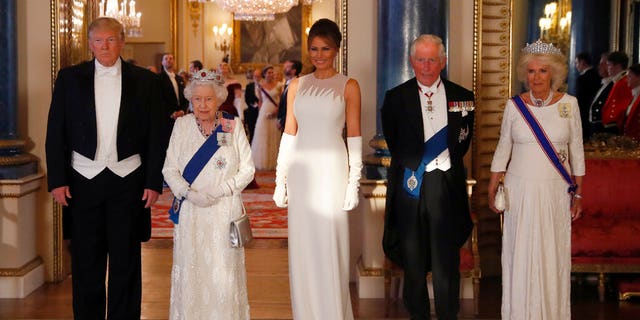
From left, US President Donald Trump, Britain's Queen Elizabeth II, first lady Melania Trump, Prince Charles and Camilla, the Duchess of Cornwall pose for the media ahead of the State Banquet at Buckingham Palace. 

From left, US President Donald Trump, Britain's Queen Elizabeth II, first lady Melania Trump, Prince Charles and Camilla, the Duchess of Cornwall pose for the media ahead of the State Banquet at Buckingham Palace.  (AP)

“For any man to bungle white-tie dress – something so regimented, so steeped in tradition, so well-documented – he must be a man who doesn’t bother with the details, who doesn’t avail himself of ready expertise, who refuses to be a student of history or even of Google,” Givhan writes. “White-tie attire is more science than art.”

She goes on in pain-staking detail to lay out how a white-tie outfit should be properly worn, and how, in her view, the “president’s iteration of white tie at the state banquet at Buckingham Palace was, in a word, a mess.”

WHY DID MELANIA TRUMP, QUEEN ELIZABETH, KATE MIDDLETON AND CAMILLA PARKER BOWLES ALL WEAR WHITE TO THE BUCKINGHAM PALACE BANQUET?

Givhan then turned her critiques to First Lady Melania Trump's outfits. Though her descriptions were far less critical, Givhan surmises that the First Lady’s choices told “a deliberate fashion story, not one rooted in historical truth.”

“(Melania) Trump often looked like she was a fashion trooper on a stealth mission,” Givhan writes.

GET THE FOX NEWS APP

And though Trump’s “adult” children” looked “slightly better” in their white tie than their father did, they looked equally as uncomfortable in Givhan’s view.

In short, Givhan says, President Trump “could have done so much better.”

Let's block ads! (Why?)


https://www.foxnews.com/politics/washington-post-columnist-links-trumps-fashion-sensibilities-to-diplomacy-says-attire-is-more-science-than-art

2019-06-07 07:59:50Z
CBMijwFodHRwczovL3d3dy5mb3huZXdzLmNvbS9wb2xpdGljcy93YXNoaW5ndG9uLXBvc3QtY29sdW1uaXN0LWxpbmtzLXRydW1wcy1mYXNoaW9uLXNlbnNpYmlsaXRpZXMtdG8tZGlwbG9tYWN5LXNheXMtYXR0aXJlLWlzLW1vcmUtc2NpZW5jZS10aGFuLWFydNIBkwFodHRwczovL3d3dy5mb3huZXdzLmNvbS9wb2xpdGljcy93YXNoaW5ndG9uLXBvc3QtY29sdW1uaXN0LWxpbmtzLXRydW1wcy1mYXNoaW9uLXNlbnNpYmlsaXRpZXMtdG8tZGlwbG9tYWN5LXNheXMtYXR0aXJlLWlzLW1vcmUtc2NpZW5jZS10aGFuLWFydC5hbXA

Kamis, 06 Juni 2019

Fashion Industry Prioritizes Sustainability, Addressing Climate Change on the Runways and Off - ELLE.com

image

Courtesy of the designer.

Anyone who thinks the fashion industry doesn’t care about climate change would have done well to drop in at the Collina Strada show at New York Fashion Week in February. Models walked the runway wearing a collection made from 75 percent dead-stock (surplus) fabric, accompanied not by a thudding bass but by a rousing speech from the teenage environmental activist Xiuhtezcatl Martinez. The beads on the clothes came from recycled ocean plastic, a collaboration with the organization 4Ocean. For designer Hillary Taymour, the event presented an opportunity to publicly reckon with how she and her peers have fallen short when it comes to sustainability.

Fashion brands’ green initiatives can often come across as lip service: While the claim that the industry is the second-most-polluting in the world has been debunked, its toll on the environment is undeniably significant, marked by widespread chemical use and a heavy carbon footprint. Meanwhile, fast fashion encourages shoppers to refresh their closets constantly, sending clothing from sales floor to landfill with alarming speed. According to the Ellen MacArthur Foundation, 73 percent of materials used to produce clothing end up either in landfills or burned; less than 1 percent is reused.

Unfortunately, Ready to Wear fall 2019
A look from model and influencer Luka Sabbat's Unfortunately, Ready to Wear, a collection of technical garments and accessories meant to protect against the ravages of climate change.

arian DiCianno/BFA.com/Courtesy of Luka Sabbat and NRDC

But a growing number of designers and executives seem intent on having a serious conversation about sustainability—and, more importantly, making real moves to decrease their environmental impact. We’re not just talking about the longtime environmental champions, like Stella McCartney, a leader in the use of materials like vegetarian leather and faux fur, and Livia Firth, cofounder of the sustainability consultancy firm Eco-Age and creator of the Green Carpet Challenge. (The latter uses red-carpet moments to raise awareness of environmentally friendly fashion. What better way to get the public excited about sustainability than Gisele in a fabulous gown?) It’s now de rigueur for luxury brands to have an executive devoted to all things green. Cases in point: Marie-Claire Daveu, chief sustainability officer at Kering, and Sylvie Bénard, corporate environment director at LVMH.

There’s an entire fashion task force tackling the plastic problem. We’ve all seen the horrifying images of trash-strewn shores and realized we need to stem the tide. Burberry has set a goal of making all its plastic packaging reusable, recyclable, or compostable by 2025, and Courrèges artistic director Yolanda Zobel is phasing out vinyl from her collections for the brand, which became closely associated with the Space Age material in the 1960s. (Thinking about the future sometimes requires getting creative about honoring the past.)

Denim is one of the most problematic sectors of the fashion industry because its production pollutes and wastes water. But labels have become more conscious of the issue. Last year, G-Star Raw launched what it calls its Most Sustainable Jeans Ever; its summer 2019 collection took things one step further by using just a two-dip (rather than the usual eight-dip) dyeing process—saving 75 percent of the water normally required.

Others are focusing on maximizing what they have. Young designers such as Marine Serre and Chromat’s Becca McCharen-Tran have leaned into crafting clothing from surplus fabrics, a restriction that hasn’t limited the exuberance of their work in the least. Chopard, under the guidance of eco-minded artistic director and co-president Caroline Scheufele, has become a proponent of ethically sourced gold and has minimized its reliance on new metals by recycling as much as 70 percent of its own production waste.

Chromat fall 2019
A move to Miami inspired Chromat designer Becca McCharen-Tran to theme her collection around ocean pollution. Models sported fishing-net “trains” tangled with plastic waste.

ANGELA WEISS

Marine Serre fall 2019
The set for Marine Serre’s show was designed to look like a post-ecological-apocalypse bunker, with models wearing antipollution masks.

IMAXTREE.COM

Streamlining production doesn’t just happen on the factory floor. Photographer Alexi Lubomirski, best known to the world for taking Prince Harry and Meghan Markle’s official engagement and wedding pictures, strives to conduct his fashion shoots with the smallest carbon footprint possible. In April, he launched the Creatives4Change initiative, asking his colleagues to cease working with fur, feathers, and exotic skins, which the photographer already avoids in his own work. Diane von Furstenberg and power photography duo Inez van Lamsweerde and Vinoodh Matadin have already signed on.

Area fall 2019
Area spelled out a foreboding message by linking upcycled laser discs, chain mail–style.

Sophie Sahara/WWD/REX/Shutterstock

Comme des Garcons fall 2019
At Comme des Garçons, Rei Kawakubo entangled models in netting, bubble wrap, and oil-slicked rubber—topped off with hazmat-like hoods—in what felt like a nod to our current environmental plight.

FirstView.com

Entrepreneur Carmen Busquets, who predicted the rise of luxury e-commerce as a founding investor of Net-a-Porter, sees sustainability as the new way forward. She has made it a point to invest in companies like Unmade, which aims to stanch mass production by enabling brands to offer custom clothing on demand, and Sana Jardin, a fragrance company with a closed-loop production system that turns its waste into products like scented candles and orange blossom water. Nadja Swarovski of crystal maker Swarovski, in addition to sitting on the company’s executive board and leading its sustainability efforts, set up the Swarovski Foundation in 2013 to support environmental organizations like the Nature Conservancy and Barefoot College.

Increasingly, it seems that there’s a cost to not establishing sustainability measures. With growing consumer attention on our environmental crisis, brands that don’t make moves to reduce their impact are inevitably going to miss out. Fashion may never be completely zero waste, but that’s no reason not to try.

This article originally appeared in the July 2019 issue of ELLE.

GET THE LATEST ISSUE OF ELLE

Let's block ads! (Why?)


https://www.elle.com/fashion/a27684562/fashion-designers-sustainability-conservation/

2019-06-06 12:00:00Z
CBMiVWh0dHBzOi8vd3d3LmVsbGUuY29tL2Zhc2hpb24vYTI3Njg0NTYyL2Zhc2hpb24tZGVzaWduZXJzLXN1c3RhaW5hYmlsaXR5LWNvbnNlcnZhdGlvbi_SAQA

The Fashion School Graduates: Where Are They Now? | Education, The State of Education | BoF - The Business of Fashion

NEW YORK, United States — While dissertations and final collections strike fear in fashion students, their most challenging assignment is finding a job in their field of study — or even in the industry at all.

“It’s always been a competitive industry, but there’s just so many talents graduating and there’s a limited number of vacancies,” Sara Kozlowski, director of education at the Council of Fashion Designers of America, told BoF. “Even with the much more focused specialisations and degree pathways, my team and I encounter emails so often from great students, great graduates, who are really challenged to find roles.”

Recruitment sites such as US-based Recruiter reports vacancies in fashion design have increased nationwide by nearly 25 percent since 2004, with an average growth of over 4 percent per year. But as social media has broken down the once-opaque industry walls, taking with it the impenetrable reputation fashion previously enforced, interest in working in the industry has also increased and enrolment in fashion schools has inflated. Zoklowski has noted in recent years some institutions experienced "enrolment increases tripling student populations."

The issue is global, with graduates abroad suffering the same employment struggles. Students from all over the world experience an “overwhelming concern” in finding a job, says Karen Harvey, industry recruitment expert and chief executive of her namesake consulting group.

UK-based graduate career services company Prospects reports on its website that over 85 percent of fashion graduates in the UK are employed. However, “just over half [54 percent] of fashion graduates [in the UK] go on to get a career in fashion or design, and then others also go into PR and marketing,” Charlie Ball, head of higher education intelligence at Prospects, told BoF.

Kozlowski sees similarly low employment figures for fashion design graduates and says the CFDA’s last survey of 23 US schools revealed “only ten percent of [fashion design students] were going into design roles.”

Fortunately, fashion degrees don’t just equip graduates to work in one industry. Transferable skills learnt in fashion’s higher education, like the discipline earned dedicating hours in a studio, increases employability in other fields should students choose, or have to, find work elsewhere.

BoF sat down with five fashion graduates carving out careers in adjacent fields and asked how they use their degrees to further their vocations.

Keith Kirkland, co-founder and engineer at Wear Works based in New Jersey, studied Handbag and Shoe Design at Fashion Institute of Technology

Keith Kirkland, co-founder of Wearworks | Source: Courtesy

“Originally, I was a mechanical engineer. I was born and raised in Camden, New Jersey, which was one of the poorest and most dangerous cities in the country when I was growing up, so there was a lot of poverty, crime and challenges to the educational system. It took me six years to get my engineering degree and after working for six months, I was laid off. So I thought, I’ve always been good at art and I love engineering, so I applied for the Handbag and Shoe Design course at FIT.

“Fashion gave me a deeply discerning eye. For example, patternmaking forces you to think through the next 100 steps — you play a chess game in your head. I use those skills of envisioning an entire process all the time, even problem-solving around strategy for my company today. Fashion also gave me the ability to understand that design is a very iterative process. Emphasis is placed on the moment you find a solution and not recognising that all the work you do, especially the failures, are contributing to that “ah-hah” moment.

“After I graduated from FIT, I joined Coach as a handbag engineer in 2011. I absolutely loved my job, the artistry and craftsmanship, but we were engineering these bags that last lifetimes, but our business model needs us to sell you a new bag every six months. I thought there has to be another way to use design to help forward humanity.

“I then went to Pratt Institute to get a Masters in Industrial Design before co-founding Wear Works, a company that builds products and experiences that communicate information through touch. Our first product is called Wayband, a wearable haptic navigation device for the blind and visually impaired, which navigates a person’s end destination using only vibrating cues.

“Now, when I explain what I did, with industrial design, technology, fashion and now creating wearable technology to help blind people, it makes perfect sense. But when I was going through it, it was confusing. Hindsight is 20:20 and I would say, follow your joy and know that the path, when you look back, will make sense.”

Rossana Orlandi, gallerist and interior designer based in Milan, studied Fashion Design at Istituto Marangoni

Gallerist and designer Rossana Orlandi by Gianni Basso Vegamg | Source: Courtesy

“I always liked being creative through art and design, but I wanted to learn how to explain my creativity. A friend of mine said Istituto Marangoni was an amazing school, so I said why not?

“While I was at fashion school, there was this new energy. Fashion school opens your eyes and your mind to everything, and it makes you learn how to problem-solve quickly. I also learnt to be unexpected and creative. It was great to have a 360 degree education, learning what has happened and what will happen, because fashion works in advance.

“I also fell in love with knitwear at school because I could work by myself and experiment on this small machine. But while I was working in knitwear, I was working two years in advance and I was always late with my collections. It was depressing work.

“I decided to stop working in fashion because it became more business and less emotion. The atmosphere was completely different and it wasn’t my world anymore. I decided to dedicate my career to my hobby instead, which is design, and that’s why I opened my gallery — to share my passion for design. The design world is so beautiful and so interesting — as it was when I started to work in fashion. [It is] full of emotion, creativity and energy.

“It is also a world where you can think because we are not oppressed with timing. We don’t have to produce six collections a year, for example. There’s no one point where everything should be ready. But the new challenge is not to design something that is beautiful but to design something that also respects the world.

“One of the skills that I think the job market wants in students today is sustainable practice. It’s a bit clinical, but since I started working with recycled plastics, I’ve seen huge problems but also huge possibilities. Sustainability is a new way of thinking and a global way to live. Waste is a huge problem and everyone should be taught about the waste of products. For example, what is the waste of my paintings?

“We have to think in a circular way and I think we should totally change our education [system], not only in fashion, but in the ways we live. I think that the main point is to educate not only from a creative point of view but also a way of thinking. We are the solution but we don’t have many years to solve the problem.”

Abigail Rands, self-employed creative director based in Cape Town, studied Fashion Brand Management at Polimoda

Creative Director Abigail Rands | Source: Courtesy

“I was interested in the idea on how to create a brand identity through fashion, but it wasn’t really about fashion for me. It was more of a bigger thinking approach — how can I understand more about brands? Florence was also an exciting city for me, with the Renaissance thinking and multidisciplinary approach, and I learnt about storytelling, mythology, and architecture, which really helped me in the work that I do today.

“I run my own eponymous design business and through that I work on a few other businesses that my brother and I own. One is a South African NPZ brand, which is the equivalent of a champagne made in South Africa. We launched that brand about 6 years ago and we’ve taken it from a small, unknown brand to the biggest selling NPZ brand in South Africa.

“I also relaunched a small boutique hotel; I work on a charter boat, which is an extension of the small hotel experience based in the Seychelles; and then there’s a wine distribution company that my father started 30 years ago, which is working with 60 different South African wine farms on their distribution and marketing.

“I was interested in fashion but I always knew that I would be doing a lot of different things. The most important thing for me is my freedom, and I’ve tried to set up my business so that I can be as remote as possible. Then I get to work on all the different projects from wherever I am in the world.

“The course really taught me to take risks and bare my soul more than I ever had before. Polimoda gave me the freedom to make mistakes and I take that to everything that I do. Just feeling the freedom to make mistakes has helped a lot.

“I think, now more than ever, the careers that we know today won’t exist. We have to be very flexible and open to working in new creative ways.”

Masayoshi Anotani, DJ and music producer based in Tokyo, studied Fashion Design at Bunka Fashion College and Coconogacco

DJ and Music Producer, Masayoshi Anotani | Source: Courtesy

“I grew up in Japan and I went to Bunka Fashion College, studying fashion design. But at Bunka, they only taught me how to make clothing, like how to use a sewing machine. They didn’t teach me how to design or how to be a creator or an artist. I wanted to study more artistic things.

“Coconogacco taught me how to create. There, I think it’s about what you make, it’s about who you are and what your original ideas are. They teach their students about originality.

“Despite studying fashion design, I had been thinking about music for five or six years. But you design fashion by doing research and finding some motifs, which is a similar approach to making music and using different materials in your music. For example, every kind of sound has a story. So, if I use a particular sound, that is because it means something.

“Fashion always has some story too and I think the ability to make stories or atmosphere is the same in music and fashion. The two industries are made from many parts of the same story and culture. I use cultural references mixed together, like in fashion and music.

“Today, I am based in Tokyo and I have a daytime job in a music-related company doing graphic and web design, but I am also a DJ and music producer under the name Mars89. I’m always making music for my own production. Coconogacco taught me how to make something in an original way and I think I am making music in their way.”

Ryan Ashley Malarkey, tattoo artist based in New York, studied Fashion Design at Fashion Institute of Technology

Tattoo Artist Ryan Ashley Malarkey | Source: Courtesy

“I grew up in a small town in Pennsylvania and FIT was the first place that I felt safe to be myself. I was around other people that were serious about bettering themselves, so FIT was the perfect nurturing sanctuary for me to develop myself as an artist, a designer, a person.

“I graduated as the Critic Award winner of my class and I took a job at the jewellery house Meryl Diamond Ltd. I started off as a design assistant and left 5 years later as the in-house artist and associate designer. But I didn’t like the industry at all. [Almost] every design house is a well-oiled machine with hundreds of people working on each collection. With tattooing, I get to design for clients, for the human body, and it is more of a one-on-one experience.

“When I first realised tattooing was for me, I thought I’d wasted all these years in the fashion industry. But the time I spent in fashion has given me the best education I could imagine to go into tattooing. For example, when you design blazers, you have to fit the shoulder, chest, back and arms. In tattooing, you need to make something to fully fit that area but as one piece of artwork. You have to drape your stencil onto the body and design it as a drape form, so it’s almost exactly like draping a muslin onto body forms.

“I don’t think there are many tattooers that have the education I do in terms of human anatomy: how the body moves and how it changes when it moves. I’ve been able to pull off tattoos that fit the body like they’re tailored.

“All of the lessons are universal for translating my designing from fashion into tattooing. Fashion is what they’re directed towards but most of the important things I learned at FIT I’ve been able to translate into this next industry. I went to fashion school because I like decorating the human body. That’s my passion. Sometimes it takes a while to narrow down what you’re actually passionate about but if you take the time to really figure yourself out, that’s the way you’ll end up being in a position that fits you.”

Explore our full report on The Best Fashion Schools in the World 2019 here.

Related Articles:

Is Business School Worth It?

How to Get the Most out of Your Fashion Education

The Best Fashion Schools in the World 2019

Let's block ads! (Why?)


https://www.businessoffashion.com/articles/education/the-fashion-school-graduates-where-are-they-now

2019-06-06 04:25:00Z
CBMiZGh0dHBzOi8vd3d3LmJ1c2luZXNzb2ZmYXNoaW9uLmNvbS9hcnRpY2xlcy9lZHVjYXRpb24vdGhlLWZhc2hpb24tc2Nob29sLWdyYWR1YXRlcy13aGVyZS1hcmUtdGhleS1ub3fSAWhodHRwczovL3d3dy5idXNpbmVzc29mZmFzaGlvbi5jb20vYW1wL2FydGljbGVzL2VkdWNhdGlvbi90aGUtZmFzaGlvbi1zY2hvb2wtZ3JhZHVhdGVzLXdoZXJlLWFyZS10aGV5LW5vdw
Rabu, 05 Juni 2019

Report shows customers want responsible fashion, but don't want to pay for it - Forbes

A new report from e-commerce personalization platform Nosto showed that of 2,000 US and UK-based shoppers surveyed, sustainable practices and fair wages for workers were top consumer demands for modern fashion retailers.

It also showed, however, that shoppers don't always want to pay for the extra costs associated with them.

The report revealed that while 52% of consumers do want the fashion industry to follow more sustainable practices, only 29% of consumers would pay more for sustainably-made versions of the same items. Additionally, 62% of consumers would like to receive discounts on sustainable clothing items.

There appears to be a disconnect between the idea of sustainable fashion and where consumers, especially of younger generations, actually spend their money.

Data from a report by ecological certification company Oeko-Tex illustrated that while that 69% of Millennials say they look into claims of sustainability and eco-friendliness when researching clothing purchases, only 37% actually bought clothes from brands with that focus.

With this in mind, it’s no surprise a new report showed sustainability efforts in the fashion industry are slowing down as a whole. However, some clothing retailers have discovered a more sustainable approach actually helps solve business problems, albeit with some trade-offs.

Clothing brand Christy Dawn is pushing ahead with eco-friendly efforts and ethical labor practices, undeterred by the implications. For the Los Angeles-based clothing company, which creates short-run editions of women’s apparel items from deadstock fabrics, it was a rocky start with quality control issues that made them lean fully into responsible fashion.

“When we were first getting started, we learned quickly you get what you pay for,” said Aras Baskauskas, Christy Dawn’s co-founder. He explained that when they initially tested production with a lower-cost team, the product suffered. In the end, they decided to pay about 35% more for a small team of four who were more expensive, but delivered much higher quality products.

Baskauskas went on to say that since then, the team of four has grown to a team of about 30, which works on-site at the company’s headquarters in downtown Los Angeles. The production team has a clean and safe working environment, is paid fair wages, gets paid vacation time, and is provided healthcare benefits.

The only downside of these efforts: Margins are smaller. For Christy Dawn, this is a reality they’ve accepted and now embrace. With their average cost per item averaging $80, their 3X markup puts them in the $220 retail pricing range. “Many fashion retailers strive for 8X margins, but we’ve made a conscious decision to run an ethical business and to keep our costs lower for customers,” Baskauskas said.

While the use of deadstock fabrics means they do miss out on economies of scale, Baskauskas explained this approach also helps them stay agile and able to release new, limited-run products every week.

Other fashion brands experiencing rapid growth have different hurdles to face as they work to maintain ethical labor and sustainability practices.

With Jéan, a two-year-old Australian fashion brand with a Bali-based production team, found itself growing from 400 units sold to 14,000 in just a few weeks.

With the rapid spike in growth, co-founders Evangeline Titilas and Sami Lorking-Tanner knew their production model needed to evolve quickly. While their small team in Bali included a few team members working from the comfort of their own homes, they now needed a central hub where a larger production team could work together as a group for the execution of fabric processing, sewing, quality control, and packaging.

In a few months, they were able to open a new worksite in Bali and to grow the production team to 60 employees, all of which are paid above-average wages. The two 26-year-old female founders now visit every other month for four weeks at a time to work alongside the team.

So how have they managed to scale so quickly and stay devoted to sustainable and ethical practices? A smart sales strategy has helped. As a direct-to-consumer brand, they roll out four small product ranges per year, but focus mostly on their perennial, best-selling styles.

“It's an extremely effective model that breaks from the traditional model most fashion labels use, which includes creating large collections throughout the year and then selling/distributing and discounting at the end of the product life cycle,” said Evangeline Titilas, one of the brand’s co-founders. “For us, we only introduce small, trans-seasonal ranges. We're breaking away from the linear traditional fashion system of take, make, and dispose.”

The strategy is working so far: The brand often sells out of the perennial styles and has had a wait list of over 1,000 people who’ve signed up for updates on restocking of a single product.

Sustainable approaches are working in these two use cases, but we still have to consider what this means for the industry as a whole. What are fashion retailers to do? Should they rise to meet these consumer demands and risk the gamble of customers not buying into sustainable practices, or should they continue to conduct business as usual?

Fashion consultant Nicole Giordano of StartUp Fashion recommends that when considering an approach to more eco-friendly efforts, brands should first zero in on the values they hold as a company. From there, they can find ways to implement sustainability related to their core mission rather than trying to accomplish all of their goals at once.

“You can always add more components of sustainability as you go, but if brands try to do too much from the start, they run the risk of hitting too many obstacles and giving up on their businesses...especially if they’re self-funded,” she said.

Progress, be it large or small, is good news when it comes to sustainable and ethical practices in the fashion world.

Let's block ads! (Why?)


https://www.forbes.com/sites/kaleighmoore/2019/06/05/report-shows-customers-want-responsible-fashion-but-dont-want-to-pay-for-it/

2019-06-05 14:30:07Z
CBMigQFodHRwczovL3d3dy5mb3JiZXMuY29tL3NpdGVzL2thbGVpZ2htb29yZS8yMDE5LzA2LzA1L3JlcG9ydC1zaG93cy1jdXN0b21lcnMtd2FudC1yZXNwb25zaWJsZS1mYXNoaW9uLWJ1dC1kb250LXdhbnQtdG8tcGF5LWZvci1pdC_SAYUBaHR0cHM6Ly93d3cuZm9yYmVzLmNvbS9zaXRlcy9rYWxlaWdobW9vcmUvMjAxOS8wNi8wNS9yZXBvcnQtc2hvd3MtY3VzdG9tZXJzLXdhbnQtcmVzcG9uc2libGUtZmFzaGlvbi1idXQtZG9udC13YW50LXRvLXBheS1mb3ItaXQvYW1wLw

The Future Of Fashion Retail Is Already Here: Will You Adapt? - Forbes

Today, there is a new kind of commerce forming. It is a blend between both offline and online experiences. It involves a combination of customers, retail and e-commerce. We are beginning to see this with companies such as Tesla, Amazon, Walmart and Peloton, as they blend online and offline elements of their businesses and pioneer the future of retail.

Peloton showrooms are a great example of this new trend: They not only sell bikes and workout machines, but also fitness clothes, and give customers the opportunity to use its machines with on-screen instructors. This combination brings the gym experience to the customer. Tesla also has showrooms to help customers experience its cars.

Here are three ways you, too, can create more meaningful experiences in your retail shop.

1. Turn your in-person returns into a customer experience opportunity.

Think through the return process that you currently have in place. Now, think of a way to maximize the experience for your customers. Most stores have a return policy that allows customers to buy something online and then return it in person. But have you thought about where you make customers go within your store to return items? If you look at where Amazon installs its pickup and return stations, you will notice they are by the end of the stores. Most people don’t like having to return items, so why not make that experience more meaningful and enjoyable?

Consider launching a section for styling services close to where customers return items. Could you better utilize your floor plan to help customers discover more that your store has to offer? If you have room to expand, launch a mini nail salon next to the area where customers must go to return items.

Thinking through the return experience can help you to deliver more value to your customers so that they enjoy the time they spend at your location. I used to own a clothing store and had a hair and nail salon within the store, which made it more than just a pain to buy clothes.

2. Create family-friendly experiences.

Fewer people are shopping in malls these days, due in large part to the ease of buying items online. This is unfortunate for brick-and-mortar store owners, but family members and groups of friends are still looking for the experience that malls once provided. When I used to go to the mall with my friends, we may have needed new clothes, but we really went to meet up and spend time together.

An example of the importance of experience-building can be seen in Tyra Banks’ latest project, a modeling theme park for girls, set to open in the Santa Monica outdoor shopping mall by the end of 2019. Then there are experiences such as the Museum Ice Cream, where you can interact with ice cream-themed art pieces and meet new people. One brand I work with gives customers access to elaborate high-end sets and professionally produced backdrops in front of which to take selfies.

Think about how you can make the experience in your store memorable and fun for the whole family. Can you make branded backdrops that would be great for customer selfies? (Be sure to come up with a hashtag so visiting customers can tag your brand on social media!)

3. Host community-building offline events.

I pride myself on bringing community together from the online experience to the offline experience. This might take the form of pop-up locations for temporary events to bring an online community together for a good cause. Consider having a social mission in tandem with your business growth goals. I can’t stress this enough — a mission serves as the foundation for community building.

Having a social mission as part of your business brings your customers together under a common interest: to help benefit the social cause you support. This makes for a real connection with the customer that you can’t get online, and it can lead to increased online sales later. When you build an authentic community, customers will think of you when they go to buy something online. Focus on facilitating direct connections to build long-term customers.

The next retail store that I launch will involve cutting-edge fashion virtual reality; instead of a dressing room, patrons will choose what they want to see on themselves in a smart mirror. I want it to be an experience. The next time you are in a retail store, try to notice the elements that create an experience there, and think of how you could add that type of experience to your store.

Let's block ads! (Why?)


https://www.forbes.com/sites/theyec/2019/06/05/the-future-of-fashion-retail-is-already-here-will-you-adapt/

2019-06-05 12:30:00Z
CAIiEIjA2YUQCNPFMLpvhAkTLg8qFQgEKg0IACoGCAowrqkBMKBFMKGBAg

Selasa, 04 Juni 2019

The fashion industry gave Barbie an award. Does she really deserve one? - The Washington Post


Barbie received the Board of Directors’ Tribute from the Council of Fashion Designers of America on Monday night. (Bill O'Leary/The Washington Post)
Fashion critic

NEW YORK — The fashion industry honored itself Monday night with a glittery gala that celebrated the work of designers challenging our concept of beauty, elevating enduring style over fads and working to forge a future that is respectful to the environment.

It also honored Barbie.

At its annual awards ceremony at the Brooklyn Museum, the Council of Fashion Designers of America gave the doll its Board of Directors’ Tribute, which in recent years has gone to former first lady Michelle Obama, equal rights advocate Gloria Steinem, entertainer and activist Janelle Monáe and former head of Planned Parenthood Cecile Richards.

To be clear, the CFDA did not give a posthumous award to Ruth Handler, the woman who created Barbie in 1959, or to Lisa McKnight, the woman who today oversees the Barbie brand. The tribute, presented by actress Yara Shahidi, went to the doll itself — a doll that has delighted children, infuriated feminists, inspired designers, confounded critics and launched a thick body of think pieces from would-be women’s studies lecturers who have lamented the doll’s impact on everything from children’s body image to female identity.


Barbie has increased the diversity in its range of dolls, and its "Dream Gap” program is meant to help girls set their aspirations as high as possible. (Patrick T. Fallon/Bloomberg)

The timing of the award coincides with the doll’s 60th anniversary. Because of her over-the-top representation of femininity, Barbie is also camp, which is the subject of the current Costume Institute exhibition at the Metropolitan Museum of Art. Indeed, the singer Kacey Musgraves showed up at the exhibition’s camp-themed opening gala last month dressed as a life-size version of the buxom, blond doll. And while, the CFDA made it clear that Barbie — or more accurately, the doll’s manufacturer, Mattel — was not one of the sponsors of the awards evening, the toymaker and the fashion industry have a long history of cross-promotional collaborations.

The award, as its name suggests, was determined by the trade organization’s board, which includes brand names such as Michael Kors, Vera Wang, Prabal Gurung and Tracy Reese. The enthusiasm for Barbie was not unanimous. But no matter.

“It’s not a sin,” said Diane von Furstenberg, the outgoing chairman of the CFDA. (She passed the torch to her successor Tom Ford Monday night.)


"It's not a sin," said Diane von Furstenberg on the CFDA award presentation to Barbie. It's a decision to spark conversation. (Nicholas Hunt/Getty Images)

The Barbie award is not biblical in its wrongheadedness, but it doesn’t do the fashion industry any favors. When design houses are wrestling with social ills related to diversity, women’s advancement and treatment in the workplace and fashion’s role in the broader culture, celebrating the fact that a doll company is finally doing what a doll company should have been doing all along is a sign of an industry that doesn’t seem to grasp the depth and breadth of its responsibility — and, more important, its potential.

McKnight, the senior vice president of Barbie and Dolls, accepted the award, and highlighted the brand’s Dream Gap program, which is meant to help girls set their aspirations as high as possible. McKnight underscored the increased diversity in the range of dolls, noting there was an astronaut Barbie and President Barbie long before there were real women in space and before an actual woman won the popular vote for president.


Yara Shahidi, right, and Lisa McKnight pose in the winner's walk with the Board of Director's tribute award for Barbie. (Evan Agostini/Evan Agostini/Invision/AP)

Barbie “is a platform for ideas and stands for girls’ empowerment,” said McKnight in an interview before the awards. But even that bit of corporate cheerleading seems disconnected from the awards. After all, there’s no CFDA category for best childrenswear designer.

Over the years the fashion industry has given awards to products and ideas. It has celebrated Hush Puppies, the Gap and Instagram. It has honored brands, such as Supreme, that some might argue have done more to dampen fashion’s creativity than energize it. But for the most part, fashion has kept its focus on entities that have set the industry on a new path, whether it be how products are sold and marketed or how sportswear and luxury are defined. An industry that is overwhelmingly for and about women has focused on celebrating those who have advocated on behalf of women — on behalf of their right to control their body, define themselves on the public stage and delight in the pleasures of beauty and craftsmanship without being ridiculed as shallow or frivolous.


CFDA board member Vera Wang, left, and Ciara at the awards gala at the Brooklyn Museum. (Nicholas Hunt/Getty Images)

McKnight said Barbie has 90 percent name awareness globally, which is one of those free-floating statistics that comes detached from any details: Awareness among girls? What age? Which countries? And what exactly does “awareness” mean? The problem with bestowing a CFDA award on Barbie is not about popularity. It’s not that Barbie is bad. It’s this: Barbie, despite all the marketing and platform-blah-blah-blah, is still a doll. And women are not. They are not objects or infantile or without agency.

That might be an obvious distinction, but it’s one with which the culture — some men, many legislatures — still struggles. It’s one reason many women remain uncomfortable discussing how they use fashion to communicate an idea, a mood or opinion. Critics argue any acknowledgment of a woman’s fashion is demeaning to her. But that’s only true if fashion is seen as a game of dress-up and the women who enjoy it as having only as much thoughtfulness as a doll.


The Dolce & Gabbana suit and Herve Pierre hat worn by first lady Melania Trump that observers parsed for meaning. (Victoria Jones/AFP/Getty Images)

It’s jarring to see the industry honor Barbie in the same way it did Obama. The former first lady underscored fashion’s usefulness as a form of diplomatic communication and as a symbol of national pride. And that is one of the main reasons an entire social media dialogue can erupt over the Dolce & Gabbana white suit with navy trim and the coordinating hat by Hervé Pierre that Melania Trump wore in London Monday. Was it too Princess Di? Too “My Fair Lady?” Or was it simply Trump favoring the designers, the silhouette and a color that makes her feel comfortable and appropriate? After all, Trump wore a white suit and hat to welcome French President Emmanuel Macron and his wife, Brigitte, to the White House in 2018. People ask what Trump’s clothes mean because we understand that clothes speak even when the wearer does not.

Honoring Barbie is a celebration of fashion as aesthetics rather than fashion as a considered extension of identity — and the latter definition is the reason we care so deeply about how we are seen, treated and depicted by Seventh Avenue. It’s an understanding for which the industry has fought. And that profound satisfaction of feeling recognized and heard on one’s own visual terms was a common refrain throughout the evening.


Honoree Jennifer Lopez poses with her award from an industry that embraced her curves and helped her define her public identity. (Evan Agostini/Evan Agostini/Invision/AP)

As the Fashion Icon of the year, entertainer Jennifer Lopez delivered a heartfelt thank-you to an industry that embraced her curves and invited her into its inner circle. And in telling the story of her fashion evolution, from hip-hop girl to red carpet star, Lopez offered a reminder that fashion is not simply about clothes on a body, but about the way that we want to be understood by the world.


Newly anointed CFDA chairman Tom Ford presents Jennifer Lopez with the Fashion Icon award. (Nicholas Hunt/Getty Images)

New designers and veterans were also honored: costumer Bob Mackie, along with Brandon Maxwell, Rick Owens and the Row’s Mary-Kate Olsen and Ashley Olsen. Emily Adams Bode was best emerging designer. Alexander McQueen’s Sarah Burton received the International Award, newly underwritten by Valentino Garavani and Giancarlo Giammetti. And other honorees included writer Lynn Yaeger, editor Carine Roitfeld and fashion sustainability trailblazer Eileen Fisher.


Ashley Olsen and Mary-Kate Olsen win a CFDA award for their accessories under their brand The Row. (Nicholas Hunt/Getty Images)

A gobsmacked Brandon Maxwell wins best womenswear designer at the CFDA awards. (Nicholas Hunt/Getty Images)

Each winner offered a reminder of how designers make fashion look deceptively easy. “I’m so charged to be in an industry where we wake up every day to make women feel good,” said Maxwell in his thank-you remarks.

But doing fashion well means engaging in the challenging, complicated work of reaching far below the surface to get at our shared humanity. Fashion is not always successful in that endeavor. But that’s the essence of its mission.

A doll has meaning. A doll can stand as an impactful symbol. But it should never stand in for the woman in all of her intelligent, grown-up, stylish complexity.

Read more:

Gabriela Hearst is dressing women for a new era of political power

Let's block ads! (Why?)


https://www.washingtonpost.com/lifestyle/2019/06/04/fashion-industry-gave-barbie-an-award-does-she-really-deserve-one/

2019-06-04 16:24:46Z
52780308424398

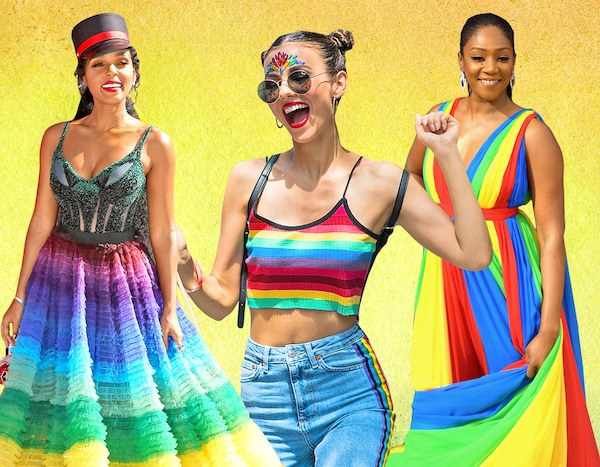
Rainbow Fashion to Show Your Pride in Style - E! NEWS

Let's block ads! (Why?)


https://www.eonline.com/news/1045937/rainbow-fashion-to-show-your-pride-in-style

2019-06-04 10:30:00Z
CAIiEOcaA1rN6dqyKUGixWZX1X8qGQgEKhAIACoHCAowq_7zCjCt4tQCMPa0pwY